Types of Boiler in the Philippines: A Complete Buyer's Guide
Daftar Isiexpand_more
Types of Boiler in the Philippines: What You Need to Know
Choosing the right types of boiler affects your operating cost, fuel flexibility and plant safety. In the Philippines, boilers are essential in sugar milling, rice processing, food manufacturing, hotels and power generation. A boiler heats water or generates steam via combustion or electricity, and every installation includes critical auxiliary lines like blow-down pipes. At 3G Electric, we have supplied industrial boiler-related components for over 35 years, including BRADY pipe markers that keep blow-down lines clearly identified.
How Boilers Work: Key Concepts
All boilers work on the same principle: fuel or electricity heats water to produce hot water or steam, which is then distributed through piping to process equipment. The main differences are in heat-exchanger design, operating pressure and construction.
- Fire-tube boilers: hot gases pass through tubes immersed in water. Simpler, cheaper and easier to maintain.
- Water-tube boilers: water passes through tubes heated by external flue gas. Higher pressure and capacity.
- Electric boilers: no combustion; use immersion elements. Clean, compact and ideal for smaller loads.
- Condensing boilers: recover latent heat from flue gas, boosting efficiency.
- Biomass boilers: burn agricultural residues like rice husks and coconut shells.
Boiler Type Comparison
| Boiler Type | Pressure Range | Steam Capacity | Efficiency | Typical Fuel |
|---|---|---|---|---|
| Fire-Tube | 10–20 bar | 1,000–15,000 kg/h | 85–90% | Diesel, natural gas |
| Water-Tube | 20–100 bar | 10,000–250,000 kg/h | 88–95% | Coal, biomass, gas |
| Electric | Up to 30 bar | 50–10,000 kg/h | 99% | Electricity |
| Condensing | 1–15 bar | 200–5,000 kg/h | 95–105% (NCV) | Natural gas |
| Biomass | 10–30 bar | 1,000–50,000 kg/h | 80–90% | Rice husk, wood chips |
Types & Applications in Philippine Industries
Fire-tube boilers are the most common in Philippine food, beverage and textile plants because they are inexpensive and easy to operate. Water-tube boilers are specified when steam pressure above 20 bar or very high capacity is required, such as in cogeneration plants and large sugar mills. Electric boilers suit commercial laundries, hotels and small factories where clean operation is a priority. Condensing boilers are becoming popular in HVAC systems for their lower fuel consumption. Biomass boilers help agri-processing plants turn rice husks and coconut shells into cheap, renewable steam.
Selection Criteria: How to Choose the Right Boiler
- Determine required steam pressure. If your process needs above 20 bar, choose a water-tube boiler rather than a fire-tube.
- Calculate steam capacity. Size the boiler in kg/h based on peak demand, not average load, to avoid shortfalls.
- Check fuel availability. In provinces without natural gas, diesel or biomass may be more practical.
- Consider footprint. Electric and fire-tube boilers take less space than large water-tube systems.
- Plan for maintenance. Water-tube boilers require skilled inspection; fire-tube units are easier for local crews.
- Label blow-down piping. Use BRADY boiler blow-down pipe markers on all discharge lines to support safety and audit compliance.
Boiler Blow-Down Pipe Markers: Keep Your Plant Safe
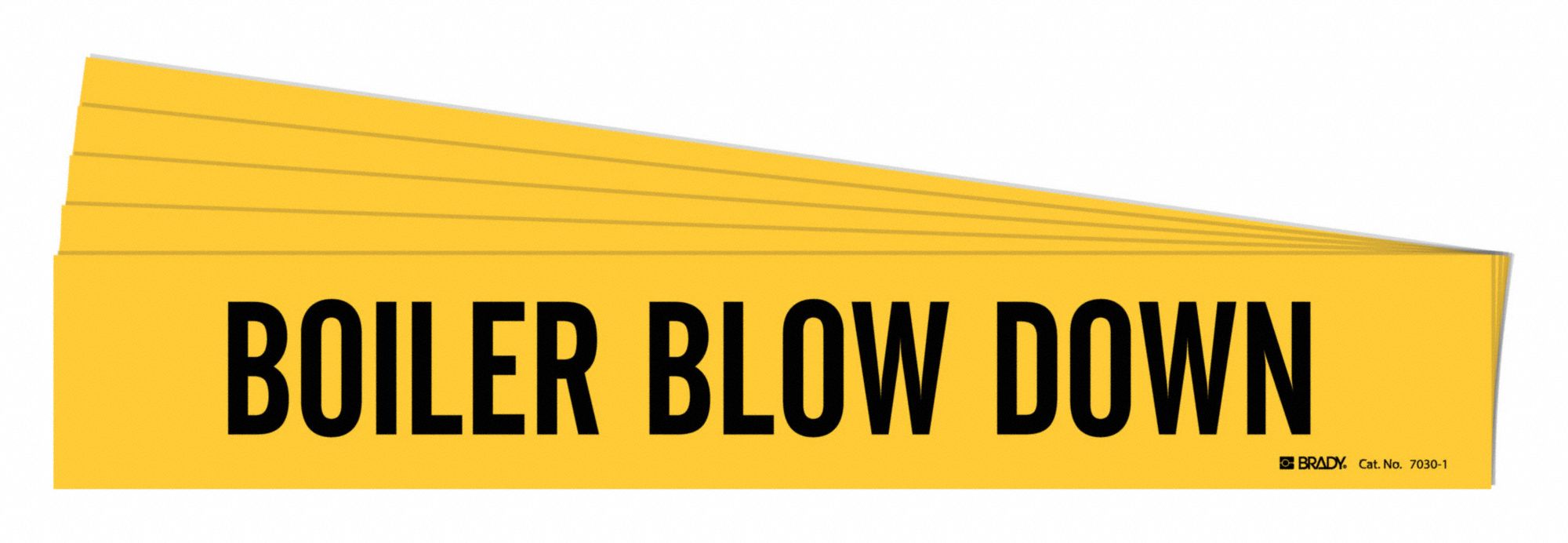
Boiler blow-down lines remove concentrated solids from the boiler drum. These lines carry hot, pressurised water and must be clearly marked. BRADY markers are supplied in yellow (danger) and green (safe/process) color options, with or without directional arrows, to match your pipe-identification standard.
| Model | Color / Legend | Pipe OD | Pack Qty | Arrows |
|---|---|---|---|---|
| BRADY Yellow Boiler Blow Down Pipe Marker | Yellow / Black | 3/4–2-3/8 in | 4 markers | No |
| BRADY Green Boiler Blow Down Pipe Marker | Green / White | 3/4–2-3/8 in | 4 markers | No |
| BRADY Yellow Large Pipe Marker | Yellow / Black | 2-1/2–7-7/8 in | 5 markers | No |
| BRADY Yellow Arrow Pipe Marker | Yellow / Black | 3/4 in and smaller | 5 markers | Yes |
| BRADY Yellow Extra-Large Pipe Marker | Yellow / Black | 8 in and larger | 5 markers | No |
For green-coded systems, we also stock BRADY Green Industrial Pipe Marker and BRADY Green Arrow Pipe Marker for smaller pipe diameters.
Why Source from 3G Electric
3G Electric is a Philippine industrial solutions provider with more than 35 years of experience across machining, electrical, power transmission, HVAC, pumps, instrumentation, welding and combustion systems. We stock 12 boiler-related products in this category, including BRADY pipe markers, and support every order with technical guidance and nationwide delivery. We interpret your requirement, source the right solution, and provide after-sales support.
Frequently Asked Questions
What are the most common types of boiler in the Philippines?
Fire-tube and water-tube boilers are the most common. Fire-tube units are widely used in food, beverage and textile plants, while water-tube boilers are specified for higher pressures and capacities in sugar mills, power plants and large industrial facilities.
How do I choose between a fire-tube and water-tube boiler?
Choose a fire-tube boiler for pressures up to 20 bar and capacities below 15,000 kg/h. Choose a water-tube boiler when you need higher pressure, faster response to load changes, or capacity above 15,000 kg/h.
What does boiler blow-down mean?
Boiler blow-down is the controlled removal of water from the boiler to reduce dissolved solids and sludge. It helps prevent foaming, scaling and corrosion. The blow-down line carries hot water under pressure and must be clearly labeled for operator safety.
Where can I buy boiler pipe markers in the Philippines?
3G Electric supplies BRADY boiler blow-down pipe markers in yellow and green, with and without arrows, for pipe diameters from 3/4 inch to over 8 inches. Contact us for sizing advice and same-day quotation.
Do I need directional arrows on pipe markers?
Directional arrows are recommended on long pipe runs so operators can identify flow direction. For boiler blow-down lines, arrows help staff understand where the discharge goes. Both arrow and no-arrow versions are available from 3G Electric.
Key Takeaways
- Fire-tube boilers are the most economical choice for low-to-medium pressure steam.
- Water-tube boilers handle higher pressure and capacity for heavy industry.
- Electric and condensing boilers offer clean, efficient alternatives for smaller loads.
- Always label boiler blow-down lines with BRADY pipe markers for safety compliance.
- 3G Electric provides expert selection advice and fast Philippines-wide delivery.
Ready to upgrade or maintain your boiler system? Contact 3G Electric today for quotes, sizing assistance and technical support.


